

The 2025 Global MOOC and Online Education Conference successfully convened its Session 3 recently. Centered on the core theme of “Ethics, Governance, and Trust in AI-Empowered Education,” the session addressed the pressing challenge of how education systems can adopt AI responsibly while protecting privacy, ensuring fairness, and strengthening public trust. Experts explored the necessary governance models and ethical safeguards required to support technological innovation without compromising educational equity.

In keynote address, Jordi Plana, Deputy Director of the UNESCO International Institute for Higher Education in Latin America and the Caribbean (IESALC), emphasized that higher education is experiencing a period of uniquely rapid transformation driven by AI . He advocated for a human-centered approach where technology serves pedagogical purposes rather than replacing human interaction, calling for ethical principles to guide its use. Highlighting practical initiatives and a new AI competence framework, he urged for international collaboration to bridge digital divides and establish a trustworthy, inclusive educational ecosystem.
Shi Yuanchun, President of Qinghai University, presented its AI-powered teaching transformation, facilitated through collaboration with Tsinghua University. To bridge gaps in digital and AI literacy among educators and learners, the university has implemented tailored training programs, virtual teaching environments, and intelligent learning platforms, alongside integrating AI-enhanced curricula developed by Tsinghua University. These initiatives have strengthened academic performance, modernized instructional approaches, and promoted the widespread adoption of AI tools in education.
Sean McMinn, Director of the Center for Education Innovation from the Hong Kong University of Science and Technology (HKUST) highlighted the curriculum’s crucial role in ensuring ethics, governance, and trust as AI reshapes learning. He argued that fragmented or purely technical courses fall short in addressing AI’s real-world impact. HKUST’s response integrates holistic AI literacy, mindset development, and interdisciplinary collaboration to prepare students as adaptive co-creators with AI.
Guadalupe Vadillo, Director of Distance Learning High School of National Autonomous University of Mexico (UNAM) addressed the trust crisis in generative AI from psychological and ethical angles. She highlighted the polarised responses—from over-reliance to excessive caution—common among educators and students, and stressed the need to critically address AI’s unreliability and opacity. To rebuild a sustainable foundation for trust in human-AI collaboration, she proposed establishing clear operational guidelines—such as pre-use content verification and requiring AI systems to reference authoritative, transparent sources.
Chet Chealy, Rector of the Royal University of Phnom Penh, spoke on behalf of universities in the developing world, exploring pathways to leapfrog development despite resource constraints. He noted that digitalization offers unprecedented opportunities to overcome geographical disadvantages. By integrating top-tier international MOOC resources into local curricula, the university has not only filled gaps in advanced coursework but also accelerated the internationalization of its faculty. Chealy emphasized that this model of leveraging global resources offers a cost-effective, high-efficiency roadmap for institutional capacity building for universities across Southeast Asia and the Global South.
Michael Phillips, Professor at the School of Curriculum Teaching & Inclusive Education at Monash University, shifted the focus to the transformation of the educator. Viewing AI through the lens of pedagogical innovation, he argued that technology must transcend its role as a mere efficiency tool to become a catalyst for reshaping the teacher’s role and revolutionizing instructional design. Phillips emphasized that the future of teacher education lies in equipping educators with the capacity to deeply integrate technology with pedagogy, transforming them from traditional knowledge transmitters into architects of future learning ecosystems.
Ganbat Danaa, Director of the Open Education Institute at the Mongolian University of Science and Technology (MUST), highlighted a strategic approach to overcoming geographic barriers. He detailed the university’s initiative to institutionalize digital learning by establishing a dedicated Open Education Institute, transforming online education from a peripheral tool into a core academic function. Danaa emphasized the critical role of MOOCs in democratizing access to engineering and technical education, ensuring that high-quality resources reach learners across Mongolia’s vast territory, thereby enhancing the nation’s capacity for engineering talent development.
Jaime Alberto Leal Afanador, Rector of the National Open and Distance University of Colombia (UNAD), concluded the keynote series by highlighting social inclusion. Leveraging UNAD’s extensive distance education experience, he positioned technology as a vital bridge across social and geographic divides. He advocated for harmonizing technical advancement with human-centered values, ensuring that AI application in mass education is equally guided by efficiency and empathy. His vision reinforces technology’s role in democratizing access to high-quality education for every learner.
Andréa Daher, Professor Emeritus at the Institute of History of Universidade Federal do Rio de Janeiro, contributed a profound humanistic perspective to the conference. She proposed that advancing in the intelligence era requires more than technological innovation—it calls for reimagining human coexistence. Daher stressed that education should foster meaningful engagement and genuine exchange between human and artificial intelligence, while preserving their unique voices. She encouraged universities to cultivate students’ ability to navigate diverse forms of intelligence and maintain mutual understanding. For Daher, the ultimate task is to keep the art of dialogue alive, ensuring that the essence of human connection is preserved even when interacting with non-human agents.
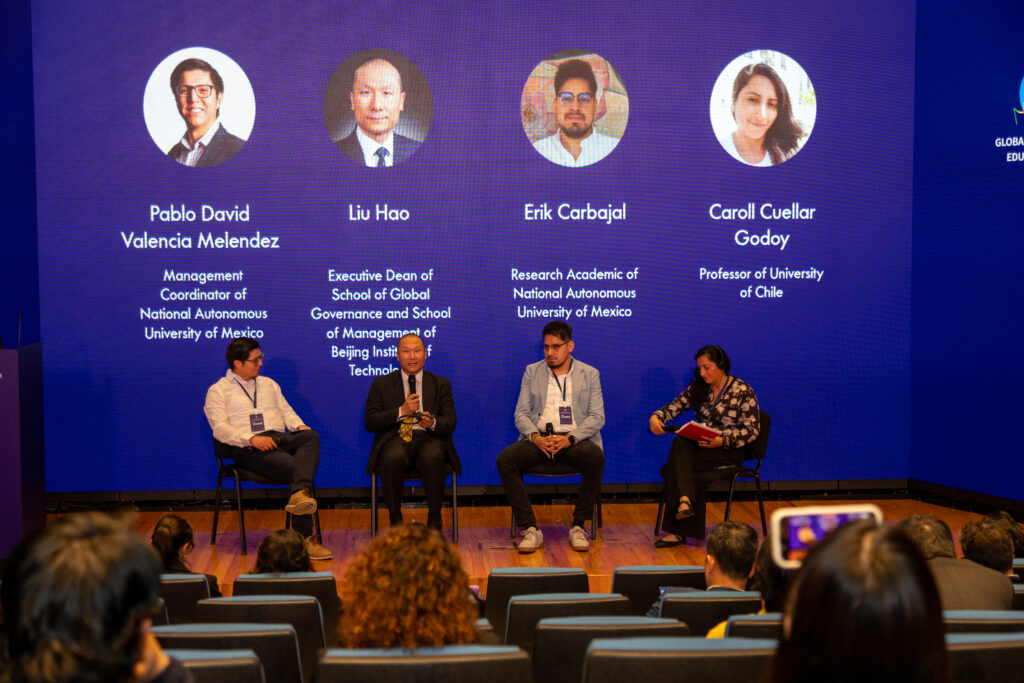
During the Panel Discussion, panelists engaged in an insightful conversation on governing AI in higher education. Liu Hao, Executive Dean at Beijing Institute of Technology, advocated for active AI use in real educational settings to understand its benefits and limits through practice. He noted AI could reform higher education by challenging traditional governance, where AI-enabled students constructively pressure professors to improve teaching quality and outcomes; Erik Carbajal, Research Academic at National Autonomous University of Mexico, identified trust as fundamental for AI adoption, emphasizing transparency’s central role. He argued that ethics already permeates learning environments and stressed that transparency grows from trust, which is strengthened when humans retain control over AI systems and decisions, aligning practices with institutional missions; Caroll Cuellar Godoy, Professor at University of Chile, shared institutional challenges in adopting AI within a School of Medicine, overcoming bureaucratic inertia and distrust by pioneering a formal AI policy. Success relied on a community-centered approach built on literacy, participatory engagement, and mutual transparency, including clear disclosure guidelines in courses, to inform future institutional development plans.
The discussion underscored that responsible AI adoption requires balancing innovation with ethics, building trust through transparency and human oversight, and aligning governance with institutional missions. It concluded that beyond technical solutions, clear governance, shared accountability, and sustained communication are essential for human-centered, inclusive AI innovation in education.
The conference reached a broad consensus: The core of AI-empowered education lies not in the accumulation of technology, but in ethical governance, curriculum reconstruction, and the establishment of trust, ensuring that technology truly serves comprehensive human development and the realization of educational equity.
The plenary session and panel discussion were moderated by Xu Shen, Deputy Director of Tsinghua University Online Education Center, and Pablo David Valencia Melendez, Management Coordinator of National Autonomous University of Mexico, respectively.