

The Plenary Session 4 of the 2025 Global MOOC and Online Education Conference, themed “Quality, Equity, and Inclusive Access in the Digital Era,” was successfully held on the morning of December 4, 2025, Mexico time.

During the Keynote Presentations, eight distinguished scholars from global universities and institutions shared their insights and practices around quality, equity, and inclusive access in the digital era. They focused on core topics such as responsible AI integration in higher education, transformative learning models, cross-regional educational collaboration, AI-empowered medical education, and digital inclusion, offering diverse perspectives and practical solutions to promote the balanced development of global MOOC and online education.
Vladimir Starostenko, Vice-Rector for Digital Transformation and Information Security of St. Petersburg State University, shared the university’s core initiatives in integrating AI into higher education. Highlighting SPbU’s leadership in pedagogical and technological innovation, he introduced a globally recognized memorandum on responsible AI use in higher education—endorsed by leading Russian universities—which outlines ethical, transparent principles while upholding academic integrity. He also noted the university’s efforts to foster digital culture among faculty and students, including multilingual AI-focused online courses and contributions to interdisciplinary LLM training and evaluation. Starostenko concluded by reaffirming SPbU’s commitment to international cooperation in advancing responsible AI integration in higher education.
François Taddéi, Founder and President of the Learning Planet Institute, offered a forward-looking perspective on reinventing learning in the 21st century. He framed contemporary higher education within the context of global poly-crises, including climate, health, economic, and geopolitical challenges, arguing that universities must redefine their mission in an era where artificial intelligence and rapidly advancing technologies challenge traditional models of knowledge creation and transmission. Taddei proposed a planetary mission for universities, inviting learners not to compete to be the best in the world, but to collaborate to be the best for the world. He emphasized the importance of nurturing shared global commons—natural, intellectual, and digital—and called for lifelong, transdisciplinary, and learner-centered education that transcends physical, institutional, and disciplinary boundaries. He concluded by sharing the Learning Planet Institute’s efforts to co-design new learning spaces, curricula, and global graduate programs in partnership with international organizations, including the United Nations, to empower learners to address planetary challenges collectively.
Xie Shi, Vice President at Sun Yat-sen University, shared the university’s experience in online education, highlighting efforts to promote high-quality and equitable education through cross-regional online collaboration. He illustrated how synchronized virtual classrooms connect faculty and students across vast distances, ensuring access to quality teaching in different parts of China. He noted that the initiative has expanded from single courses to full academic programs, covering multiple disciplines and supporting universities across China. Xie also introduced the university’s recent extension of the program overseas, bringing high-quality courses to countries such as Indonesia and Thailand, and concluded by emphasizing that education can transcend geographical boundaries and contribute to building a global community of educational excellence.
Weimin Wang, Executive Deputy Director of the National Center for Health Professions Education Development at Peking University, addressed the challenges of the Fourth Generation of Medical Education through the development of an AI—Empowered Medical Learning Center. He outlined how technological and educational revolutions are shifting medical education toward population health, interdisciplinary integration, and widespread AI adoption. He emphasized that AI is transforming traditional teacher—student dynamics into a collaborative teacher—student—machine relationship, fostering more autonomous and personalized learning. In conclusion, he noted that such AI—driven ecosystems lay a solid foundation for accessible, lifelong, and equitable medical education.
Suzanne Graham, Academic Development and Support Senior Director at the university of Johannesburg, shared her insightful overview on digital inclusion, whose essentials includes devices, data, digital literacy, and learning capacity. She shared the experience of digital ecosystem at the University of Johannesburg, and also highlighted what AI can do for digital inclusion, focusing on AI’s potential utility for personalized learning, assistive technology. Graham, in her conclusion, shared her vision for digital inclusion, where anyone could learn anywhere, affordable data are available to all.
Cengiz Hakan Aydin, Director of the Office of Learning and Teaching Engagement at Özyeğin University, shared the university’s reflections on responding to global trends in higher education through transformative education and AI-driven innovation. He highlighted the importance of inclusiveness, sector–education collaboration, digital and AI literacy, and entrepreneurship in preparing students as responsible global citizens. Aydin introduced Özyeğin University’s learner-centered and transformative education model, emphasizing learning with AI rather than from AI, and outlined institutional efforts to integrate AI into teaching, learning support, administration, and governance. He concluded by stressing the need to build a holistic AI ecosystem that empowers students, faculty, and staff not only to use AI responsibly and ethically, but also to create AI-driven solutions that enhance educational quality, equity, and sustainability.
Jintavee Khlaisang, Director of Thailand Cyber University, shared insights on the roles of MOOC and online education in the new era, focusing on the Thai MOOC ecosystem and its philosophy. She highlighted the collaborative network of numerous universities, colleges and agencies partnering with Thailand Cyber University to build mutually beneficial relationships. Khlaisang also introduced AI-driven initiatives, including a responsibly trained learning assistant chatbot and “AI Smart Translation” aimed at overcoming language barriers for student learners. She emphasized Thailand’s efforts to advance inclusive, high-quality digital education through an integrated national learning ecosystem, while underscoring commitments to quality, equity and international collaboration in expanding lifelong learning opportunities.
Costel Negricea, Rector of the Romanian-American University, shared his reflections on the role of universities in a rapidly changing world shaped by social, economic, environmental, and technological challenges. He emphasized that education serves as a bridge toward a more resilient and sustainable future, and highlighted the Global MOOC and Online Education Alliance as a living ecosystem of collaboration, innovation, and shared commitment to quality education for all. Negricea underscored the responsibility of universities to continuously adapt their academic capacities, harness emerging technologies such as artificial intelligence, and transform knowledge into practical solutions that support communities and sustainable development. He reaffirmed the Romanian-American University’s commitment to digital innovation, inclusion, and human-centered education, and concluded by calling for sustained partnerships among universities, industries, and communities to advance equity, excellence, and global understanding.
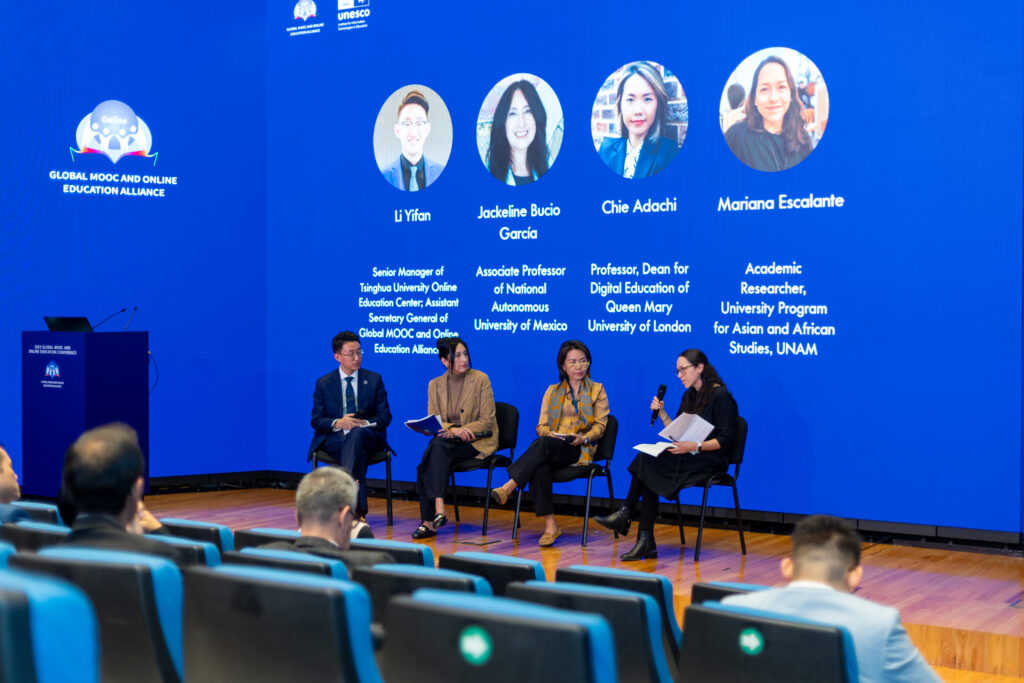
During the Panel Discussion, panelists engaged in a focused exchange on redefining quality and equity in digitally transformed higher education. Mariana Escalante, Academic Researcher at the National Autonomous University of Mexico, reframed educational quality as educational justice, arguing it should be measured by accessibility, relevance, and responsiveness to structural inequalities rather than technological sophistication, and stressed that technology can only reduce inequity when guided by strong values, ethical data use, and open, intercultural practices; Chie Adachi, Professor and Dean for Digital Education at Queen Mary University of London, highlighted the gap between institutional definitions of quality and students’ lived learning experiences, emphasizing inclusive engagement, equitable access to support, community partnerships, and flexible pathways, while cautioning against technosolutionism; Jackeline Bucio García, Associate Professor at the National Autonomous University of Mexico, emphasized the importance of collective benchmarking and cross-institutional collaboration in quality assurance, calling for localized design, low-bandwidth solutions, sustained human support, and critical governance of platforms and data to ensure digital transformation remains human-centered.
The discussion concluded that quality assurance in the digital era must prioritize equity, human agency, and shared responsibility, with technology serving as an enabling—not determining—force in building inclusive and resilient higher education systems.
The plenary session and panel discussion were moderated by Jorge León Martínez, Director of Projects and Outreach for Open, Distance and Blended Education of National Autonomous University of Mexico, and Li Yifan, Senior Manager of the Tsinghua University Online Education Center and Assistant Secretary General of the Global MOOC and Online Education Alliance, respectively.