

Co-hosted by the Global MOOC and Online Education Alliance (GMA), Tsinghua University, and the UNESCO Institute for Information Technologies in Education (IITE), the GMA Awards Special Session of the 2026 Online Education Dialogue (OED), under the theme of “AI for Futures: The New Landscape of Higher Education,” was successfully held.
The session featured distinguished speakers: Professor Vladislav V. Arkhipov (Head of the Department of Theory and History of State and Law, St. Petersburg State University), Asst. Prof. Pawana Chuesiri (Assistant Dean for Public Relations, Faculty of Veterinary Science, Chulalongkorn University), and Dr. Pushpa Kulanatha (Senior Lecturer, Faculty of Indigenous Medicine, University of Colombo), who shared expert perspectives as GMA Award winners recognized for their innovative integration of technology and pedagogy. The dialogue was hosted by Li Hongru, Manager, Online Education Center, Tsinghua University, and Assistant Secretary-General, Global MOOC and Online Education Alliance.
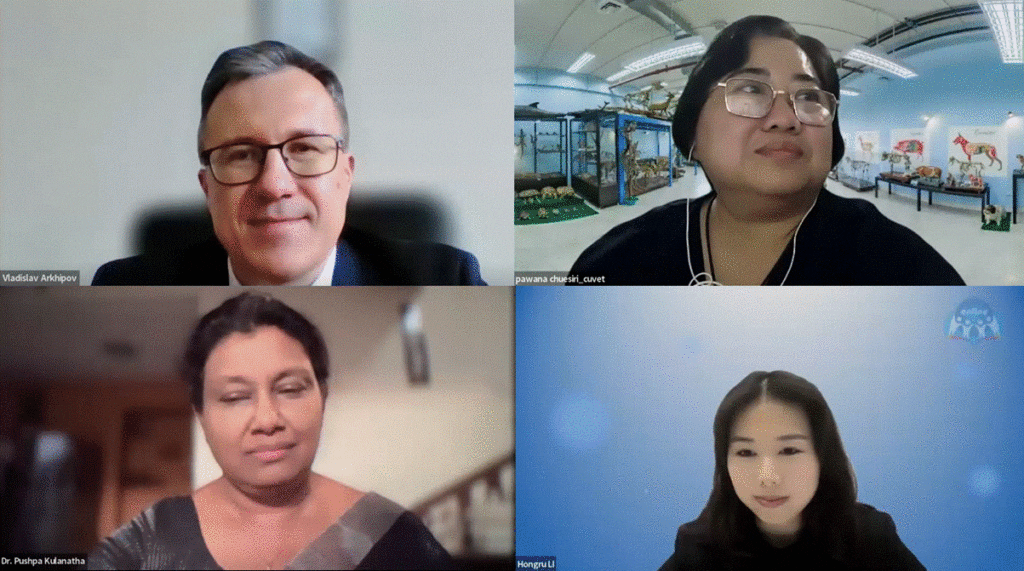
(From left to right) First row: Prof. Vladislav V. Arkhipov, Asst. Prof. Pawana Chuesiri
Second row: Dr. Pushpa Kulanatha, Li Hongru
Professor Vladislav V. Arkhipov presented on AI ethics in education, emphasizing the importance of fostering independent critical thinking rather than replacing it with AI tools. He highlighted that while AI cannot be prohibited in education, universities must focus on teaching students how to use AI critically and responsibly as a supportive instrument for human judgment rather than a replacement for memory and imagination. To maintain academic values in the age of AI, he stressed the need for AI-resistant tasks and suggested a potential return to oral defenses to ensure that the educational process continues to prize independent reasoning.
Asst. Prof. Pawana Chuesiri shared her award-winning course, “Canine Injection & Venipuncture,” which utilized a web-based simulation platform to address the practical challenges of traditional veterinary anatomy training. The platform, delivered via the university’s LMS, features 3D rotatable anatomical models and AR simulations that create a safe environment for students to build confidence and clinical skills. This innovation has shown significant improvements in student performance and satisfaction while successfully reducing the need for live animal practice. Looking forward, she discussed plans to extend this work through a circular economy approach, using sustainable materials for physical models.
Dr. Pushpa Kulanatha discussed her methodology for integrating AI with traditional Ayurvedic knowledge to make ancient wisdom more accessible to modern learners. She developed an conceptual decoder designed to transform complex Sanskrit texts into microlearning modules, specifically catering to the learning preferences of Gen Z students. She emphasized that AI should be used carefully as a tool for accessibility rather than allowing it to dictate educational content. Throughout this integration, she stressed that human wisdom, reflection, and the preservation of the spiritual and metaphysical aspects of indigenous medicine must remain central to teaching practices.
Discussion
The speakers explored the evolving nature of modern classrooms and the unique challenges of integrating AI across diverse fields such as law, veterinary science, and traditional medicine. The participants agreed that instructors should maintain direct human communication and avoid delegating student assessments solely to AI, ensuring that teacher authority and professional judgment remain indispensable. The conversation also touched upon the technical and ethical necessity of balancing the use of personal information with AI to achieve accurate results while ensuring legal compliance in handling student data and intellectual property. As 2025 GMA Awards winners, the speakers highlighted that the “soul” of a great course lies in its pedagogical grounding, where AI serves as a thought partner that supports, rather than displaces, student reasoning and ethical judgment.